Blog

  • Strange Beasts of China – Book Review

    Strange Beasts of China – Book Review

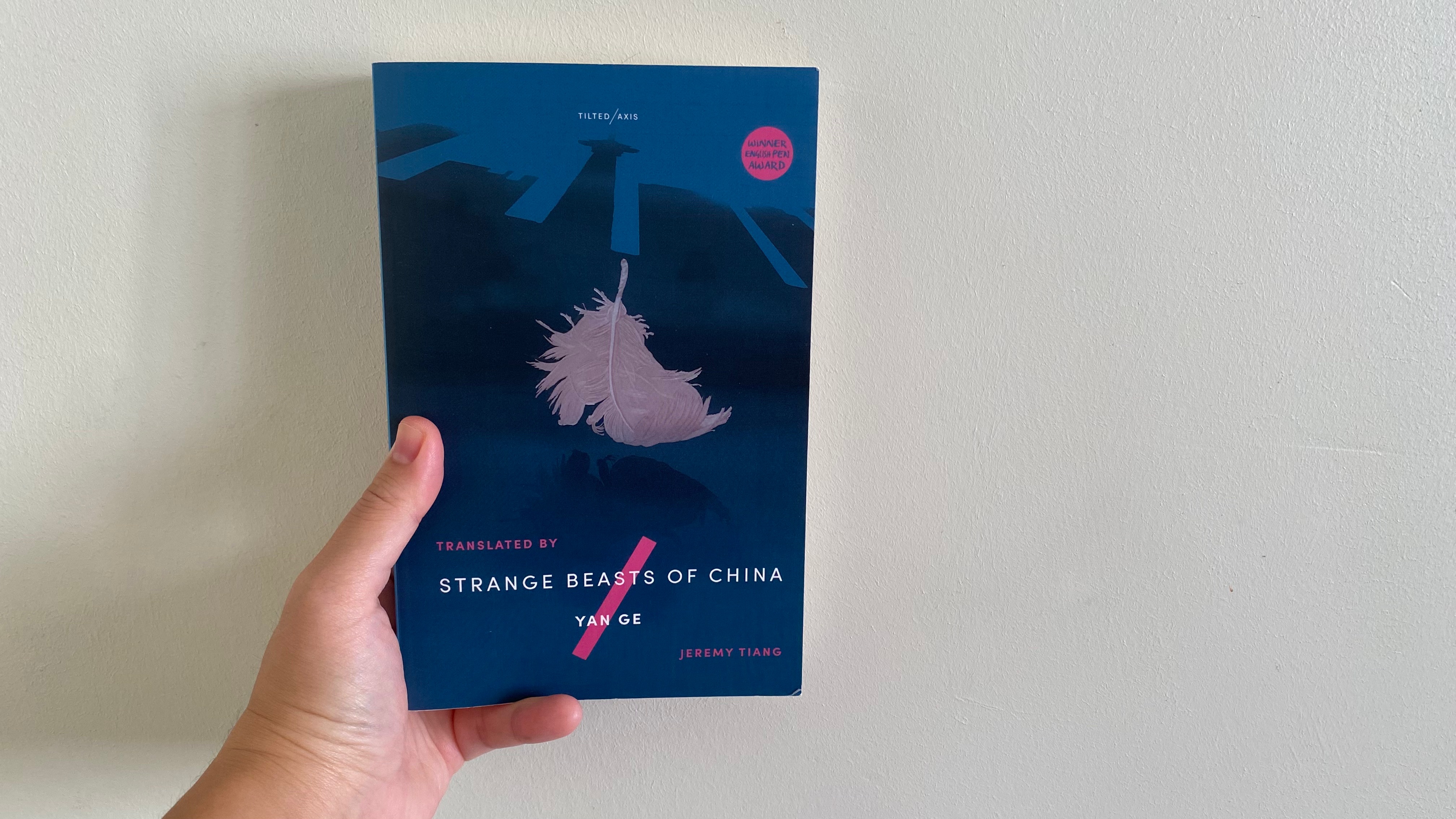
    This was one strange and very compelling book I finished in less than a week.

    Strange Beasts of China by Yan Ge is was a Christmas gift from a friend, I picked it up randomly from my shelf one day in an attempt to diversify my reading.

    In any case, the book follows a cryptozoologist as she goes around the city of Yong An, interacting with, then writing about different beasts as a journalist.

    Even though it was only in the first story that we see the appearance of a sort of queer relationship, after that intriguing beginning, I felt that it was essential to continue the story.

    I think this is the first time I’ve been exposed to magical realism in an Asian context (outside of Murakami), and it was very interesting indeed.

    It seemed like the book was providing a type of social commentary and as I’m endeavouring to keep this review spoiler free, I’ll let the reader decide on what that is about.

    In any case, this translation by Jeremy Tiang was fascinating enough that I wish to read the original but it’ll probably be years before my Chinese is up to scratch.

    Nonetheless, I highly recommend this book for all interested in literature translated from the Chinese.

    Thank you Tilted Axis Press for translating this masterpiece!


    If you enjoyed this article and would like to support Queer In Asia and help keep the lights on, do drop a tip over at: https://ko-fi.com/queerinasia.

    This is not a sponsored post. For sponsorship opportunities, please drop us a note at our Contact page.

  • Queer Easter Reflections – 20 years of being a paradoxical queer Christian

    Queer Easter Reflections – 20 years of being a paradoxical queer Christian

    Introduction

    It hurts when my queer friends tell me I’ve been brainwashed by Christianity.

    Unfortunately for me, it also stings when my Christian friends tell me that they “love the sinner, but hate the sin”.

    To be a queer Christian is to be stuck between a rock and a hard place.

    I am a paradox. A riddle that cannot be easily parsed.

    Thankfully for me, I found my tribe 7 years ago.

    After spending 10 years in a evangelical megachurch, and 3 years in a Presbyterian church, I finally found Free Community Church (FCC), Singapore’s only openly queer affirming church.

    It’s where, in my very diverse cell group made up of both straight and queer people, young and old, male and female and those in between, I found my chosen family.

    I forged close friendships with the straight family comprising a dad, a mom, and their two kids that welcomed me into their home for a New Year’s gathering when I was alone after my first major breakup.

    I spent countless hours late into the night chatting on Telegram with my trans friend on queer theology, with me learning about their Catholic faith, and them being incredulous about what Protestants believe.

    I confided in my buddies (one a panromantic demisexual, the other a bi asexual) about my various crushes, girlfriends, and subsequent heartaches with great candour. 

    Online family

    These days, Gen Z and Gen Alpha have it easier. 

    On Tik Tok, Bible scholars like Dan McClellan and Mattie Mae Motl speak about how the Bible does not condemn homosexuality nor the transgender identity.

    On YouTube, Free Community Church streams their Sunday services live every week, allowing those who aren’t able to make it to the physical location to partake in a progressive and queer-affirming sermon every week.

    On Discord, there exists at least one trans Christian community that I used to be more active on, allowing those in marginalised communities to gather and discuss topics close to their hearts.

    These were all non-existent when I was in my early 20s, figuring out how to live a queer Christian life pleasing to God.

    Instead, I drank in the books and blogposts of gay Christians from the US and UK of all stripes. 

    I wrestled with the Side A stance of Justin Lee and Matthew Vines, who believe that God is okay with having a same-sex orientation and same-sex relationships.

    I resonated with Side B Christians like Wesley Hill and Eve Tushnet, who believe that while God is okay with them being gay, God doesn’t approve of same-sex relationships nor same-sex sex.

    Somehow, I ended up in the company of Side X Christians, like how Alan Chambers once was, a proponent of ex-gay theology.

    Digital refuge

    Unable to find a single gay Christian to talk to in my evangelical megachurch of 30,000 people, I joined Choices, a support group for same-sex attracted Christians.

    Some people call them “conversion therapy”, they say that they provide “reparative therapy”, but all I knew was that I’ve finally found my people.

    It was there I found my first welcoming queer community.

    It was there I found my safe space.

    It was there I found my friends that were just like me.

    Finally, I could speak openly about my difficulties, my struggles, my desires, and be met with complete understanding and great compassion.

    I think people don’t realise that for conservative Christians, FCC is not the natural alternative.

    When I first stepped into FCC one Easter roughly a decade ago, I was discombobulated. Their theology was so foreign, so alien, so abhorrent, I could not accept it.

    Fortunately for me, conversion therapy was a stepping stone to progressive theology. I wrote about it in more detail in my book, Fearfully & Wonderfully Made: Stories from Conversion Therapy Survivors in Singapore, that you can check out to find out. All the trigger warnings apply.

    In any case, I am thankful for the meandering journey God has brought me on. For God’s ways are infinitely higher than my ways. God certainly has a keen sense of humour. That I cannot deny.

    church with stained glass windows, and pews on the left and right with an aisle to the altar in the middle
    A copyright free image has been used to protect the privacy of members of FCC.
    Photo by Karl Fredrickson on Unsplash

    The oppressed becomes the oppressor

    I don’t know why God’s people are so cruel to queer people.

    All I know is that I’ve found God to be infinitely good, perfectly faithful, and very patient indeed.

    In all my wanderings, God has been there.

    It makes sense for queer people to hate Christians, whether in Singapore, or all across the world.

    The actions of Christians can seem tyrannical, they can seem illogical, but ultimately (whether consciously or unconsciously), it stems from a distorted picture of what God is like.

    They believe that God would be cruel to, and judge the “deviant”, so they naturally behave the same way.

    Conversely, I believe God is good to everyone, so I forgive my queer friends for their cruelty, for they know not what they do.

    I’ve got a friend who is an out and proud lesbian, but a closeted Christian. She did not tell any of her queer friends when she became a Christian for fear of ridicule and judgement. 

    I happen to be in the strange Venn diagram where I occupied both “queer” and “Christian” circles, so she confided in me.

    It is unfortunate when the oppressed becomes the oppressor. But I suppose that’s just how history is. That’s just how the wheel turns.

    This Easter, I’m headed back to FCC to see my old friends and experience the joy of being fully known and fully loved, in a church that embraces all of my imperfect self.

    I do not know what the future holds for a generation of closeted queer evangelicals growing up in conservative households. 

    But one thing I know for sure.

    There will always be community if one reaches out.

    You will find your chosen family – all you have to do is to step out of what is familiar.

    I spent 13 years of my Christian life suffocating. I carried my cross so hard, it almost ended up taking my life. 

    Today, I can finally breathe free, and I am grateful for Free Community Church for making that happen. 

    Happy Easter my friends.


    If you liked this article and would like to tip Queer in Asia, feel free to contribute any amount at: https://ko-fi.com/queerinasia

  • Trans Baker’s Joy – Slowing Down with The Proofing Ground

    Trans Baker’s Joy – Slowing Down with The Proofing Ground

    Introduction

    Jean (she/her), 37, is a trans lesbian baker who runs The Proofing Ground, a home-based business located in Singapore that specialises in loaves of super soft shokupan and rustic sourdough bread, among other offerings.

    Together with her partner Leah, she desires to offer the customer an escape from “the proving ground”, where Singaporeans running the rat race need to continually prove themselves at work, and suggests that we “take a pause at The Proofing Ground”, (lovely wordplay, if I must say so myself).

    She shares that “the entire vision around the brand and everything revolves around slowing down, [and] really taking the time to make things properly.”

    “The name is also called The Proofing Ground, because, again, you know, you can’t rush fermentation, or you can’t rush a bread.

    That’s what my favourite saying is, ‘that if it needs to rise, it needs to rise.’

    If it needs to proof, it needs to proof.

    You learn to follow that cadence – [how we make the bread changes], sometimes depending on the weather, sometimes depending on how humid it is, and so on.”

    In their founding philosophy, they “offer a welcome respite to escape the daily grind, and savour the pleasures of hearty, healthy, and homemade food.”

    They invite us to “slow down, connect with loved ones, and rediscover the joy of shared experiences through the warm embrace of home.”

    Sourdough loaves from The Proofing Ground

    Setting the ground for The Proofing Ground

    A former professional at Google, Jean was inspired to start The Proofing Ground in 2023 during the tech winter then, where massive layoffs made her realise that she was living in a “gilded cage” and what she “thought was safe, is a lot more volatile than expected.”

    Both Jean and her partner wanted something they could “call their own”, something different from what they do day to day, and something “more tangible and more hands on.”

    They both landed on baking as it was something they both enjoyed.

    Jean started baking after Covid, when she finally found permanent accommodations and got an oven. She experimented with cakes, pies, and eventually landed on bread.

    Born in Germany when her parents were working there, they grew up on sourdough and found it difficult to access good sourdough locally in Singapore. So she thought of “baking for ourselves.”

    Leah likes her bread “softer and sweeter” and decided on creating the Japanese inspired shokupan. 

    Cranberry Butter from The Proofing Ground

    A variety of products for the Singaporean palate

    That’s how they ended up with their two distinct lines of products – sourdoughs and shokupans.

    At The Proofing Ground, they offer three types of sourdough, rustic, wholewheat and rye; and three types of milk bread, shokupan, choco-pan, and cinna-pan.

    To complement their fresh loaves, they also have a variety of butter, ranging from unsalted butter and sea salt butter, to compound butters such as garlic chives, garlic rosemary and truffle butter.

    They also sell kombucha, kefir and also provide various seasonal offerings.

    In addition, The Proofing Ground has recently created a picnic set, where they offer their signature bread, various beverages, and comes conveniently together with a picnic basket and mat.

    The Proofing Ground’s Picnic Set

    Tweaking recipes for a tropical climate

    It took 6 months of experimentation for Jean to finally perfect her sourdough as most of the recipes found online assume a drier, cooler climate.

    In Singapore, with our 80% humidity level and tropical temperatures, her first loaves turned out either very soggy, or very hard. 

    It “took 6 months to debug”, and only after that did she offer her bread to friends, family, and colleagues for the next half a year, who remarked that the bread was very good and that “they should sell it.”

    Inspired by their positive comments, they decided to start offering it to people they don’t know.

    In this little home-based business, they started selling 1 loaf a week, and now bake up to 10-20 loaves every week.

    Baking full time – the ideal endeavour

    However, she says that ideally they need to sell 50 loaves per week to be financially sustainable, and if they were able to get a space, would need to sell 100 – 200 loaves weekly.

    That was also part of the consideration to stay a home-based business even though they were close to signing a lease. Financially, it just didn’t make sense and would require them to work at an unsustainable pace just to make rent, defeating the purpose of their founding. 

    Back in a full time job, Jean has now decided to “approach it differently.”

    She previously used to hang onto her corporate job like it was all she had, and that she “needed to do everything to keep it” – the bakery helped fix that unhealthy relationship.

    “Now I know I have options,” she said, and while she hopes to bake full-time, is now steadily working toward that dream in a more financially sustainable manner.

    As of this writing, they are open 2 days a week and deliver islandwide.

    We are “trading rent for delivery fees” she quipped, but noted that at least that’s a “variable cost” as opposed to the fixed cost renting a unit would require, because in Singapore, logistically, the “fulfilment costs is high.”

    Pineapple Kombucha from The Proofing Ground

    Queer support heartening

    When asked what it was like living and running a business as an openly trans woman in Singapore, she explained to me that in her experience, there are usually 3 stages in a trans person’s journey.

    • Stage 1: Shy and closeted
    • Stage 2: Out and proud
    • Stage 3: Everyone who needs to know already knows. They are just living life normally.

    Jean says that she is currently at Stage 3 in her life and doesn’t bring it up unless necessary, which mirrors the other interviews I’ve conducted of individuals across Asia.

    However, she notes that the support from the queer community has been heartening. 

    Through word of mouth, and boothing at pop-ups at events like the Queer Christmas Market at Proud Spaces, it is a customer base that they naturally gravitate toward.

    Yet, for Jean, she notes that now at Stage 3, even if the both of them at The Proofing Ground are recognised as queer bakers, that is not “everything they are.”

    “At the end of the day, it is about bringing bakes to whoever might find joy in them.”

    Being Trans, Tempered by Fire

    When asked what being a trans woman means to her personally, and how her transition has shaped who she is today, Jean paused and pondered before giving a meaningful answer.

    “For lack of a better term, I would say that I’ve been ‘tempered by fire’, and have gone through experiences that many [cis people] would not have gone through,” she mused.

    Having been called names and having gone through “that sort of transition experience where that is constantly on your radar”, she has since learnt to “read people better”, “rationalised where that came from”, and “separate [their] words from intent.”

    She explains that even though such hurtful comments could be made out of either malice, misinformation or ignorance, she has since understood why “people are saying this.”

    What being trans means to her now, for “practical intents and purposes”, is that she would like society to treat her as a woman. 

    Strawberry Kombucha

    Encouragement to closeted trans folks

    Today, Jean finds joy in “spending time with friends and people” that she cares about, “preferably with food on the table.”

    Her words of encouragement to those closeted are many and nuanced.

    “For any of you in the closet, it may seem like your gender identity is everything. I have been there. It is not your [entirety]. Your self worth your life is not just around that. There are a lot more things that you are a part of, that you can be a part of. that goes beyond your gender identity.”

    “Find joy in the little things, even when life feels overwhelming.”

    For herself, going through the process of transition has made her realise a lot of things. She has learnt “not to give too many fucks” especially about what other people think.

    When asked for an example of an activity she now enjoys, she mentioned that a “newly discovered passion is singing karaoke”. She explains that she used to be “deathly afraid” of karaoke due to her voice sounding like a man”, and that it was a very visceral experience. 

    One day, while reframing, she noticed that often, “when a clearly visibly male person is able to sing in a female register, they are celebrated.”

    Similarly, “the reverse applies when a very visibly female singer is able to sing in a very deep, chesty low voice.” 

    “Most people react with, ‘Oh my God, that is so cool!’ and with that in mind, “seeing things from a different perspective”, it is now “a fun party trick” she does with her colleagues.

    Choco-pan from The Proofing Ground

    Words of Wisdom on starting a Home-Based Business

    As they hope to eventually be a successful queer business, I ask Jean if she has any advice for people interested in doing something like they did.

    “Find your community, start with that. It doesn’t have to be the queer community, it can be your local neighbourhood. Find that. if you can’t find that, try to build that.” 

    She mentioned that she was giving away free loaves to her neighbour in the early days of baking as they were so sick of eating their own bread for days on end. And that was how they unintentionally cultivated a repeat customer when their neighbours’ friends come over.

    Small acts of kindness, not being “purposely done for advertising” can have a lasting impact. It’s about “being there with the people around you.”

    Honey Kefir from The Proofing Ground

    The Proofing Ground – Highlights & Challenges

    When asked what highlights they’ve experienced since they started their journey, Jean said that when “people text back or leave a review about how they enjoyed” their bread and accompaniments, and “who they shared it with”, it means a lot as their “main motivation is to spend more time with people I love, and hearing them do the same with our breads on their table – it does quite a number on me.”

    In addition, Jean notes that seeing things she spends time and effort on, and being rewarded in words if not monetarily, is where she currently derives her satisfaction from.

    On the flip side, some challenges include the annual filing of taxes as there is a lot of paperwork to go through. 

    On top of that, as a small business, one must do everything. Like an octopus, a small business owner needs to do “operations, deal with vendors, marketing, create social media, fulfil orders, build a website, on top of the actual baking.”

    Conclusion

    The interview with Jean left me inspired and encouraged to slow down and find joy in the things I enjoy doing.

    Like her, I hope to continue bringing more articles in the weeks to come, as writing is something I truly enjoy doing.

    I hope you enjoyed this article and if you’re an individual or a business that would like to order shokupan or sourdough from The Proofing Ground, click here to check out their full menu.


    This is not a sponsored post. If you would like to explore sponsorship opportunities, do drop us a message in our Contact form.

    If you enjoyed the article and would like to support Queer in Asia financially to keep this going, please feel free to donate any amount at: https://ko-fi.com/queerinasia

  • Biromantic Greysexual in Jakarta: Finding Queer Joy Amidst Religious Persecution

    Biromantic Greysexual in Jakarta: Finding Queer Joy Amidst Religious Persecution

    Introduction

    Lady Jasmine* (not their real name), identifies as a demigender biromantic greysexual who resides in Jakarta, Indonesia.

    Having had crushes on female characters in books and movies, they first realised they were bisexual at 15 when they had their first same-sex crush. According to them, it was an “aha moment” that came with a rush of enthusiasm.

    Interesting facts about Indonesia

    Raised as a Muslim, they now see themselves as an agnostic open to different spiritual practices,  and believe in the existence of a higher power.

    A fun fact unknown to many is that atheism is illegal in Indonesia.

    In the Pancasila state ideology, atheism has been prohibited since 1966 and blasphemy laws are strictly enforced.

    According to Lady Jasmine, they note that “there are six recognised religions we have to choose and register as followers of”, which are namely, Islam, Protestantism, Catholicism, Buddhism, Hinduism, and Confucianism.

    Interestingly, the freedom of religion only exists for those belonging to these prescribed religions.

    In addition, the religion an individual subscribes to will be included on their national ID cards, and Lady Jasmine notes that it “will determine everything from our rights to where we will be buried.”

    National Monument in Jakarta, Indonesia

    Queer in Indonesia: Getting harder by the day

    When asked about what it is like being queer in Indonesia, they note that “being queer in Indonesia is unnecessarily hard.”

    They explain that they “have always been a confident person who feels no shame about my identity, yet this situation forced them to ‘tone down’ for the sake of survival.”

    According to Lady Jasmine, they noted that “back in the 1990s, Indonesia was much more open-minded than it is now.”

    In fact, they “first learned about queerness from local television, where queer-coded characters and entertainers were common and accepted.”

    They point out that they first learnt about the meaning of the word ‘gay’ from their mother. 

    “Gay is a man who is dating another man, like Uncle G,” their mom stated. 

    Uncle G was a family friend and they point out that their mother’s relaxed attitude toward the question reflects how it was back then. In the past, they said, “queer people may not be able to come out in the open, but society knew that they existed and let them be”.

    A copyright free image from Unsplash has been used in order to protect the identity of the interviewee.

    Letting go of organised religion

    Lady Jasmine shared that even though there were many reasons why they chose to let go of any organised religion, a defining one would be: 

    “If I cannot be free in my physical form, at least let me be free in my mind.”

    They revealed that they had never seen their queerness as a mistake as it felt like something “natural and inherent, just like my own hands and feet”.

    Even when they later learnt about queerness being considered a sin, they did not feel any immediate shame about it.

    In a conservative climate, they had to hide their queer identity for several years, but deep inside, they knew who they were and who they were attracted to.

    Joining a queer Muslim organisation

    While living and working in Singapore from 2019 – 2025, Lady Jasmine became actively involved with a queer Muslim organisation called Quasa

    They appreciated “how the narrative that was encouraged in Quasa was one of self-acceptance and life preservation first, according to the guidance of the sharia, instead of ‘coming out first’ as often encouraged by secular or Western queer spaces.”

    They added that Quasa taught them to emphasise “one’s relationship with the self and the Creator before seeking external validation from others.”

    “This was a really valuable time for me,” they said, as “it has allowed me to explore and accept my queer identity and even encouraged me to finally be out to people I trust.”

    Navigating queerness in Indonesia

    When asked if there was a favourite queer or queer-friendly space they patronise in Jakarta, they said that “unfortunately, due to safety reasons”, they have to “avoid visiting queer spaces in Indonesia” – at least until they “know how to do it safely”.

    In fact, when they moved back to Jakarta from Singapore in the middle of 2025, there was a panic on social media as queer books like Red, White, and Royal Blue and Yaoi manga – disappeared from online bookstores in Indonesia.

    According to Lady Jasmine, they shared that there were rumours swirling about the authorities raiding the ports for shipments of queer fiction and bookstore owners being under threats from “the above” to take down their queer book listings.

    They found it stressful to have to find a way to safely ship their personal queer book collection back to Jakarta. They contacted friends and learnt tricks to “smuggle” forbidden books, which was “a skill everyone growing up under the Soeharto dictatorship has to master”. They declined to share their methods, but said that “the books made it safely to Jakarta”.

    Queer Film Festival Raided

    When asked about queer joy and pain, Lady Jasmine gave two really poignant examples.

    They noted that back when they were in university and deep in the closet, they volunteered with the Q! Film Festival, an annual LGBTQ themed movie festival held across various locations in Indonesia such as Jakarta, Bandung, and Denpasar.

    They mentioned that they enjoyed it as they “got to do tasks like emceeing a showcase, and also ushering guests.”

    Unfortunately, the event had to be cancelled midway as some venues were raided by religious hardliners. They mentioned that the organising committee contacted all volunteers when it happened and gave them the option to continue volunteering or the freedom to quit.

    They had to quit after the raids made the news, and said that “it still gives me chills today to think that I was this close to experiencing them.”

    Finding Queer Joy

    Moving on to something more joyful.

    Even when Lady Jasmine was in the closet, they had always worn things that were “bisexual-coded”, such as cuffed jeans or sporting a bisexual bob haircut. 

    Years later as an adult, they find it amusing to note that it was almost like their “subconscious made these queer-affirming decisions even before I had the words for it.”

    In addition, when they came out to some family members and friends, most of them reacted with, “Yeah we know.” They had apparently given off ‘vibes’, even when they did not realise it. 

    A copyright free image from Unsplash has been used in order to protect the identity of the interviewee.

    On queer persecution in Indonesia

    When asked about their hopes for the future as a queer person in Jakarta, they responded that “honestly, (they) don’t have very high hopes”. 

    They acknowledged that “we’re very far from being fully accepting”, and quipped that, “at this point, I just wish that they’d just leave us alone. Like, don’t even look this way.”

    Their views are understandable given the spate of recent news on queer persecution in Indonesia such as the bill to ban LGBTQ+ content online, the caning of gay men in Banda Aceh, and the arrests of men at a private gathering in Jakarta – all of which have had chilling effects on the LGBTQ+ population in Indonesia.

    Favourite queer books

    For Lady Jasmine, the most life-defining queer fiction was the Tokyo Babylon manga series by CLAMP. It was like nothing they’d ever seen before and blends elements of magic with urban life, and created characters with a complex emotional landscape. Most importantly, the series features “the most tragic (yet delicious) queer couple (that) CLAMP has ever created.”

    In addition, they are also a big fan of KJ Charles. She writes compelling historical queer romances (often mixed with fantasy or murder mysteries) that are filled with nuanced characters. Lady Jasmine found Unfit to Print and The Secret Lives of Country Gentlemen among some of KJ Charles’ best works. 

    In addition, if one is looking for books about wizards and witches that do not belong to The Franchise That Must Not Be Named, they recommend KJ Charles’ Magpie Lord series of books.

    Turning to non-fiction, Sounds Fake but Okay: An Asexual and Aromantic Perspective on Love, Relationships, Sex, and Pretty Much Anything Else by podcasters Sarah Costello and Kayla Kaszyca was a book that really shifted Lady Jasmine’s worldview. 

    They recommend it as a self-help book for aro-ace readers, encouraging them to challenge the “should” of society that cloud our judgement, helping them live more authentically.

    To our readers who can read Bahasa Indonesian, they also recommend Queer Menafsir by Amar Alfikar, which discusses his experiences as a transman. According to Lady Jasmine, the book explores “a more queer-affirming interpretation of Islamic teachings written in a warm and intimate style”.

    Discovering their identity

    In fact, it was through reading “tons of books on asexuality”, including the one recommended above, that allowed them to discover the identity they currently identify with. 

    The asexual part of their queer identity was something that they “only discovered at 35, after coming out as bisexual”.

    At that time, they had “a very limited understanding of what asexuality was, and thought that there was no way” they could be one as they were “attracted to people of the same and different genders”.

    It was only after reading extensively about what asexuality was about that “many things just clicked”. Aegosexuality was “the first label” they identified with, but they eventually came to see themselves as more of a greysexual.

    They note that “of all my queer identities, asexuality was the one hardest to accept”. They acknowledge that they had prejudices against asexuality despite experiencing it themselves.

    Conclusion

    When asked for words of advice they would give to a younger queer person in Indonesia, this is what they had to say:

    “Be truthful about who you are, as an honourable life is not built upon lies. Also, learn to smuggle books.”

    – Lady Jasmine


    If you enjoyed this article and would like to support Queer In Asia and help keep the lights on, do drop a tip over at: https://ko-fi.com/queerinasia.